Health and Human Services hospital-level data only goes back to July 2020, and excludes hospitals reporting fewer than four hospitalizations in a given week.
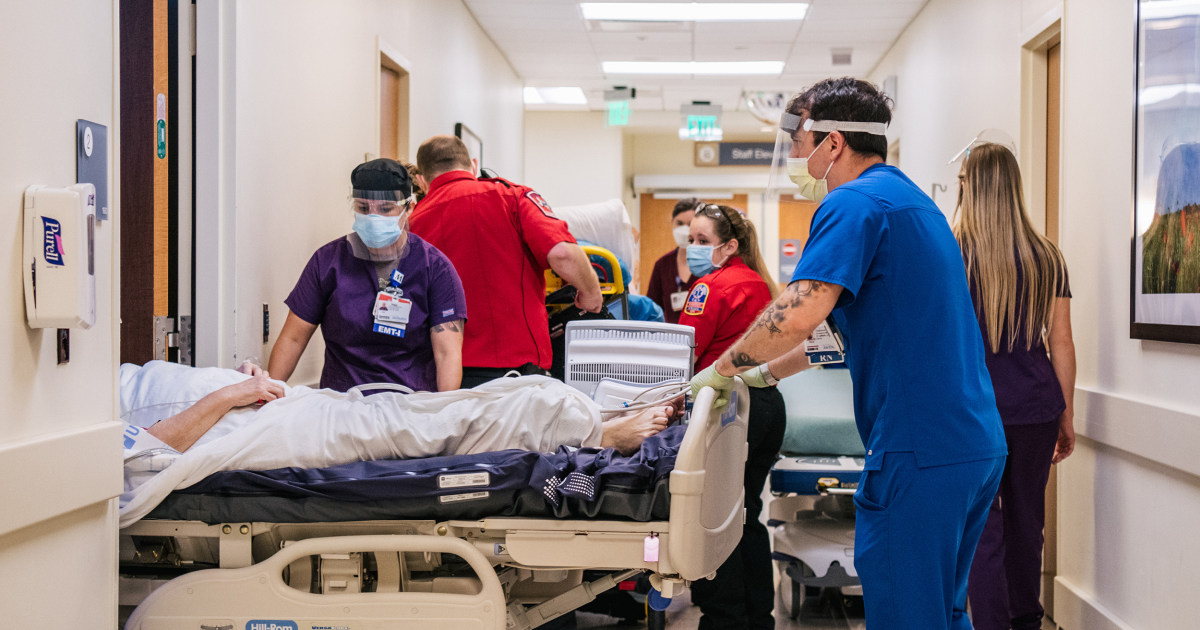
As of the week of Sept. 23, the country’s ICU capacity was about 79 percent full on average, and August saw more ICUs maxed out than in January, when the U.S. was counting more than 3,000 Covid deaths a day and before widespread Covid vaccinations.
“It’s been tough not having the ICU capacity, because that’s really where our bottleneck has been over the month of July,” said Tena Knight, associate chief nursing officer for Southeast Health in Dothan, Alabama.
“Even today, the number of ICU patients that we have, we’ve just experienced anywhere from maybe 10 to 15 patients that are needing ICU beds, sometimes upwards of 20 patients needing ICU beds, and there’s just no place to put them.”
This summer’s Covid surge has only made things more difficult for packed hospitals. In Alabama, ICUs were maxed out in the latest surge, and other states have had to resort to rationing care in certain hospitals.
Idaho began to ration health care early this month as hospital beds filled up with a deluge of Covid patients. Idaho has one of the lowest vaccination rates in the U.S., with only 41 percent of its population fully vaccinated, according to data from the Centers for Disease Control and Prevention. Currently, 55 percent of the country’s population is fully vaccinated.
By comparison, in New Jersey, where 64 percent of the population is fully vaccinated, only 45 percent of the ICU beds are filled.
There are more than 5,000 hospitals reporting weekly to Health and Human Services, with nearly 1 in 4 reporting that more than 90 percent of their ICU beds were full for the week ending Sept. 23. In early June, before the delta variant fueled a case surge, only 1 in 10 hospitals were at that level. Last week’s data shows that number decreasing slightly for the first time since July.
In Florida, about 86 percent of the ICUs are full. But data suggests that the state’s surge has ebbed, with only 39 hospitals reporting 100 percent occupancy, down from 50 percent the week prior, and down from a peak of 72 percent the week ending Aug. 26.
In Texas, data shows that ICUs have stayed more than 90 percent full since the middle of August, and have stayed around 80 percent since July 2020, with some of its hospitals reporting 100 percent ICU occupancy for months.
In McAllen, Texas, the Rio Grande Regional Hospital can barely catch a break. Located in the southern part of the state, the hospital has enough staff for 20 to 30 ICU beds a week, and data indicate they’ve been at full capacity for nearly the entire year, and much of 2020.
In an emailed statement, Adriana Morales, a hospital spokesperson, said they’re balancing the influx of patients by adding staff to increase the number of ICU beds.
Rio Grande was not the only Texas hospital experiencing repeated weeks of full ICUs. Park Plaza Hospital in Houston has seen 55 weeks of full occupancy since July 2020. HCA Houston Healthcare Southeast in Pasadena saw 45 weeks of full capacity during that time. More than 200 hospitals in the state have been maxed out at least once, but many more have tread close, with occupancies of more than 90 percent.
Burnout is another challenge in hospitals facing surge after surge.
“The strain that health care workers are under is unbelievable,” Zolnierek of the Texas Nurses Association said. “And it’s not ending. It’s been a year and a half now. After the vaccine, everyone was feeling, ‘Oh, my gosh, there’s a light at the end of the tunnel.’ And then the delta variant came, and it kind of feels like this never-ending nightmare.”
She said some of her member nurses will be retiring.
“There are some nurses that are saying: ‘I’m going to hang on, my colleagues, my patients need me right now. But as soon as we’re done with this wave, I can’t go through this anymore.’”
from WordPress https://ift.tt/3kVexgY
via IFTTT
Comments
Post a Comment